How Much Car Can I Afford Based on Salary Right Now
Figuring out how much car you can afford based on salary is simpler than you think. The 20/4/10 rule is the gold standard for car buyers in India and around the world. This guide breaks down the math, shares real examples, and helps you pick the right car budget without stretching your finances too thin.
Have you ever walked past a dealership, spotted a shiny new car, and thought, “I could actually afford that”? We have all been there. But the truth is, buying a car is one of the biggest financial decisions most people make after purchasing a home. And the question “how much car can I afford based on salary” is one that almost every buyer should ask before signing on the dotted line.
The answer is not just about what your monthly salary looks like. It is about understanding your full financial picture. Your debts, your lifestyle, your goals, and even your daily commute all play a role. This guide will walk you through everything you need to know. We will break down the rules, the math, and the real-world steps you can take right now to make a smart car buying decision.
Whether you are a first-time buyer or looking to upgrade, this article will give you the confidence to choose a car that fits your wallet — not one that stretches it to the breaking point. Let us dive in.
Key Takeaways
- Follow the 20/4/10 Rule: Put 20% down, finance for no more than 4 years, and keep total car costs under 10% of your monthly income.
- Know Your True Budget: Factor in insurance, fuel, maintenance, and registration — not just the sticker price.
- Used Cars Save Big: A 2 50 Lakh Car or a pre-owned option can cut costs significantly.
- Avoid Common Traps: Don’t stretch your loan term too long or skip the down payment.
- Match the Car to Your Lifestyle: A 5 Seater Car Under 8 Lakh often hits the sweet spot for middle-class buyers.
- Use Online Tools: A car affordability calculator takes the guesswork out of the equation.
📑 Table of Contents
- Why Affordability Matters More Than Ever
- The 20/4/10 Rule: The Golden Standard for Car Affordability
- How to Calculate Your Car Budget Based on Salary
- New Car vs Used Car: Which Fits Your Budget Better?
- How Salary Ranges Affect Car Choices in India
- Common Mistakes That Blow Up Your Car Budget
- Quick Tips to Maximize Your Car Budget
- Conclusion: Buy Smart, Not Just Big
Why Affordability Matters More Than Ever
Car prices in India have been climbing steadily. From compact hatchbacks to premium SUVs, the cost of a new vehicle can surprise you. Add in rising fuel prices, insurance premiums, and maintenance costs, and owning a car becomes a serious financial commitment. This is exactly why understanding your car affordability based on salary matters so much.
Many buyers make the mistake of looking only at the monthly EMI. They ignore the total cost of ownership. But the real question is not “Can I pay the EMI?” It is “Can I comfortably afford this car for the next 5 years?” That shift in thinking changes everything.
The Hidden Costs of Car Ownership
When you buy a car, the purchase price is just the beginning. Here are the costs most people forget to plan for:
- Car Insurance: Third-party insurance is mandatory, but comprehensive coverage costs more. Expect to pay ₹3,000 to ₹15,000 per year depending on your car.
- Fuel or Charging Costs: Your daily commute distance matters a lot here. A fuel-efficient car can save you thousands every year.
- Regular Maintenance: Oil changes, tire replacements, brake pads — these add up fast.
- Registration and Road Tax: This can be 5% to 10% of the car’s ex-showroom price.
- Parking and Tolls: If you live in a city like Mumbai or Bangalore, these costs can be significant.
All of these costs factor into your true car budget. And they all depend on your monthly salary and financial stability.
The 20/4/10 Rule: The Golden Standard for Car Affordability
If you have ever searched for “how much car can I afford based on salary,” you have probably come across the 20/4/10 rule. It is the most widely recommended guideline for car buyers, and for good reason. It is simple, practical, and works for almost any income level.
Here is how it works:
- 20% Down Payment: You should pay at least 20% of the car’s total price upfront. This reduces your loan amount and lowers your monthly EMI.
- 4-Year Loan Term: Finance the car for no more than 4 years. Longer loan terms mean lower monthly payments, but you end up paying much more in interest.
- 10% of Monthly Income: Your total monthly car costs — including EMI, insurance, fuel, and maintenance — should not exceed 10% of your gross monthly salary.
Let us look at a quick example. Say you earn ₹60,000 per month. Your total monthly car costs should stay under ₹6,000. If your EMI is ₹4,000, you have ₹2,000 left for insurance, fuel, and maintenance. This keeps you financially healthy and stress-free.
Why the 20/4/10 Rule Works So Well
This rule protects you from becoming “car poor.” That is when your car costs eat up so much of your salary that you have little left for savings, investments, or even basic needs. By capping your car expenses at 10% of income, you ensure that your car serves you — not the other way around.
It also encourages you to make a solid down payment. A bigger down payment means a smaller loan, lower interest payments, and less risk of negative equity. In simple terms, you never owe more on the car than it is worth.
How to Calculate Your Car Budget Based on Salary
Calculating your car budget is not rocket science. But it does require some honest math. Here is a step-by-step approach you can follow right now.
Step 1: Know Your Net Monthly Income
Start with your take-home salary — the amount that actually lands in your bank account after taxes and deductions. This is the number that matters for budgeting. If you earn ₹50,000 per month after tax, that is your starting point.
Step 2: List All Your Monthly Expenses
Write down your rent, groceries, utilities, existing loan EMIs, subscriptions, and savings. This gives you a clear picture of how much disposable income you actually have.
Step 3: Apply the 10% Rule
Take 10% of your net monthly income. That is your maximum monthly car budget. For someone earning ₹50,000, that is ₹5,000 per month.
Step 4: Work Backward to Find the Car Price
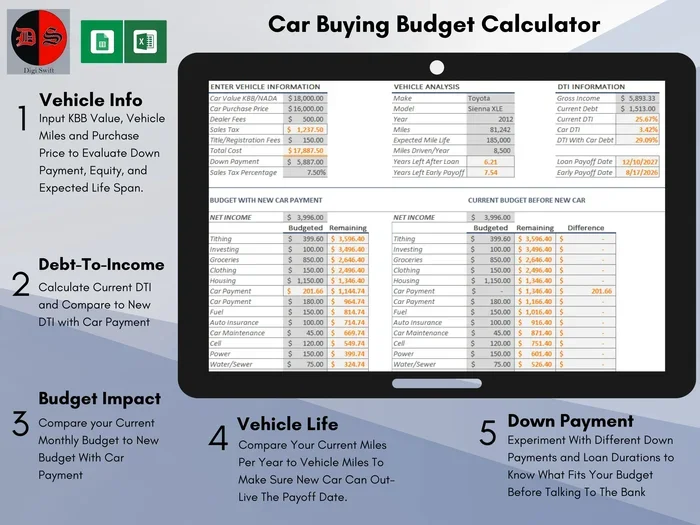
Use an online car affordability calculator or a simple EMI calculator. Input your budget, the expected interest rate, and the loan term. This will tell you the maximum car price you should consider. As a rule of thumb, with a 10% down payment and a 4-year loan at 10% interest, you can afford a car priced at roughly 4 to 4.5 times your monthly car budget.
So if your monthly car budget is ₹5,000, you should look at cars priced around ₹20 to ₹22 lakh. This is where tools and calculators really help remove the guesswork.
New Car vs Used Car: Which Fits Your Budget Better?
This is one of the most important decisions you will make. Both options have clear advantages, and the right choice depends entirely on your financial situation.
| Factor | New Car | Used Car |
|---|---|---|
| Upfront Cost | Higher | Lower |
| Depreciation | Steeper in first year | Already absorbed |
| Warranty | Full manufacturer warranty | Limited or none |
| Maintenance | Lower initially | May need more repairs |
| Insurance | Higher (based on new value) | Lower (based on current value) |
| Technology & Safety | Latest features | Older features |
For many buyers, a used car is the smarter financial move. You avoid the steepest depreciation hit, and you can often get a well-maintained vehicle for a fraction of the new price. If you are on a tighter budget, consider looking at a 5 Seater Car Under 8 Lakh in the pre-owned market. These cars offer great value and reliability.
On the other hand, if you have a higher salary and want the latest safety features, a new car might be worth the extra cost. The key is to stay within your calculated budget no matter which route you choose.
How Salary Ranges Affect Car Choices in India
Car affordability looks different at every salary level. Here is a practical breakdown to help you understand where you stand.
Salary Under ₹3 Lakh Per Annum
At this income level, buying a new car can be challenging. Focus on used cars or smaller hatchbacks. A 2 50 Lakh Car or even a well-maintained budget car under ₹2 lakh can serve you well. Consider a two-wheeler for daily commute and save up for a car upgrade later.
Salary Between ₹3 Lakh and ₹6 Lakh Per Annum
This is the sweet spot for many Indian buyers. You can comfortably afford a new compact car or a used sedan. Look at options in the ₹5 to ₹10 lakh range. A 30 Lakh Car In India might be on the higher end, but with a solid down payment and a short loan term, it is achievable.
Salary Between ₹6 Lakh and ₹12 Lakh Per Annum
With a higher income, you have more flexibility. You can consider sedans, compact SUVs, or even a 60 Lakh Car In India if you follow the 20/4/10 rule strictly. Make sure your total car costs stay within that 10% threshold.
Salary Above ₹12 Lakh Per Annum
At this level, you can afford premium cars or SUVs. However, the temptation to overspend is real. Stick to your budget, make a substantial down payment, and remember that a higher salary does not mean you should spend everything on a car.
Common Mistakes That Blow Up Your Car Budget
Even with the best intentions, many car buyers make avoidable mistakes. Here are the ones you should watch out for:
Skipping the Down Payment
Some buyers put zero down payment to keep the EMI low. This is a trap. Without a down payment, you owe the full price of the car, which means higher interest costs over the life of the loan. You also risk being underwater on the loan almost immediately.
Choosing the Longest Loan Term
A 7-year loan might sound appealing because the monthly EMI is lower. But you will pay significantly more in interest. A 4-year loan keeps your payments manageable and saves you real money in the long run.
Ignoring the Total Cost of Ownership
As we discussed earlier, the sticker price is not the full story. A cheaper car can end up costing more if it guzzles fuel or needs frequent repairs. Always factor in insurance, fuel, and maintenance when comparing options.
Buying a Car You Cannot Actually Afford
Just because a bank approves you for a certain loan amount does not mean you should borrow that much. Banks do not care about your savings goals or emergency funds. They only care about your ability to make the monthly payment. Always borrow less than what you are approved for.
Quick Tips to Maximize Your Car Budget
Want to get the most car for your money? Here are some practical tips that work:
- Negotiate the price. Do not accept the first offer. Dealers expect negotiation, and you can often save ₹20,000 to ₹50,000 or more.
- Check for manufacturer discounts. Many brands offer festive-season deals, exchange bonuses, and loyalty discounts.
- Compare loan offers from multiple banks. A 0.5% difference in interest rate can save you thousands over the loan term.
- Consider a car on rent for short-term needs. If you only need a car occasionally, renting might be smarter than buying. Check out options like a 7 Seater Car Rental In Mumbai for occasional group trips.
- Buy a car with good fuel economy. This is one of the biggest ongoing savings you can make.
- Set up an emergency fund first. Do not buy a car if you do not have at least 3 months of expenses saved.
Conclusion: Buy Smart, Not Just Big
So, how much car can you afford based on salary? The answer is different for everyone. It depends on your income, your expenses, your goals, and your financial discipline. But the framework is the same for all of us. Follow the 20/4/10 rule, calculate your true budget, and stick to it.
Buying a car should make your life better — not add financial stress. Whether you are looking at a budget hatchback or a premium SUV, the right car is the one that fits comfortably within your means. Do the math, be honest with yourself, and make a decision you will feel good about for years to come.
Start today. Use a car affordability calculator, check your budget, and take the first step toward smart car ownership. Your future self will thank you.
Frequently Asked Questions
How much should I spend on a car based on my salary?
The general rule is to keep your total monthly car costs — including EMI, insurance, fuel, and maintenance — under 10% of your gross monthly salary. This is known as the 10% rule and it helps you stay financially comfortable while enjoying your car.
What is the 20/4/10 rule for car buying?
The 20/4/10 rule means putting at least 20% down, financing the car for no more than 4 years, and keeping total monthly car costs under 10% of your monthly income. It is the most reliable guideline for affordable car buying.
Can I buy a car if my salary is under ₹3 lakh per year?
Yes, but you should focus on used cars or smaller budget options. A well-maintained car under ₹2 lakh or a compact hatchback can work well. Avoid taking large loans at this income level.
Is it better to buy a new car or a used car on a tight budget?
For most tight budgets, a used car is the smarter choice. You avoid the steepest depreciation, pay less in insurance, and often get a well-maintained vehicle at a fraction of the new car price.
How does a car loan affect my salary budget?
A car loan adds a fixed monthly expense to your budget. Make sure the EMI plus other car costs stay within your 10% limit. Never borrow more than you can comfortably repay without affecting your savings or emergency fund.
Should I use a car affordability calculator?
Absolutely. A car affordability calculator takes your salary, expenses, and loan details and gives you a clear picture of what you can afford. It removes guesswork and helps you make a confident, informed decision.