Can Lightning Strike a Car Here Is What You Need to Know
Can Lightning Strike a Car? The answer is yes, but your vehicle is built to protect you in most cases. When a lightning strike hits a car, the metal frame channels the electrical current around the exterior and safely into the ground. This car protection mechanism, known as the Faraday cage effect, keeps you safe inside the vehicle during a thunderstorm. Understanding how this works can save your life.
Have you ever been driving down the road when suddenly the sky turns dark, thunder rolls in, and you wonder, can lightning strike a car? It is a scary thought. The truth is, lightning strikes vehicles more often than most people realize. Each year in the United States alone, there are thousands of reported lightning strike incidents involving cars, trucks, and other vehicles. But here is the good news: your car is one of the safest places to be during a thunderstorm.
Understanding can lightning strike a car and what happens when it does is important for every driver. Whether you drive a sedan, an SUV, or a pickup truck, knowing the science behind vehicle safety during electrical storms can give you real peace of mind. This guide covers everything you need to know about car protection, common myths, and practical safety tips to keep you and your family safe on the road.
The next time a storm rolls in and you are on the highway, you will know exactly what to do. Let us break down the science, the myths, and the real-world steps you can take to stay safe.
Key Takeaways
- Cars act as Faraday cages: The metal frame directs electricity around you, not through you.
- Rubber tires do not protect you: They play no real role in shielding you from a lightning strike.
- Convertibles offer less protection: The lack of a metal roof reduces the Faraday cage effect.
- Pull over safely during storms: Turn off the engine, avoid touching metal parts, and wait it out.
- Check your car after a strike: Look for exterior damage, tire damage, and electrical system issues.
- Motorcycles and open vehicles are dangerous: They offer almost no car protection from lightning.
- Stay calm if struck: The vehicle exterior absorbs most of the energy, keeping occupants safe.
📑 Table of Contents
What Happens When Lightning Strikes a Car
The Moment of Impact
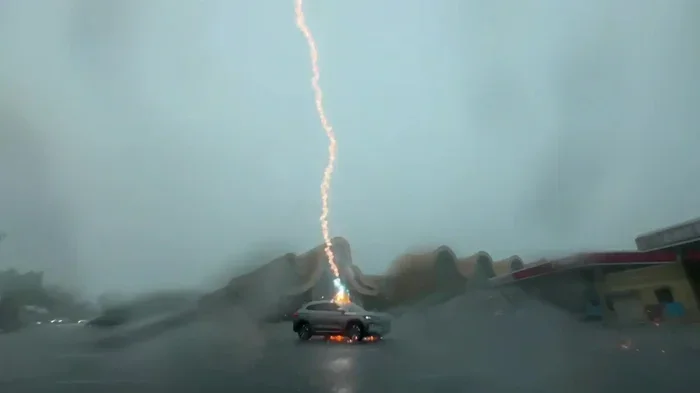
When a lightning strike hits a car, the event happens in milliseconds. A single bolt of lightning carries an enormous amount of electrical charge, often reaching temperatures of around 50,000 degrees Fahrenheit. That is hotter than the surface of the sun. But here is what makes cars special: the metal body of the vehicle acts as a shield.
The electrical current travels through the outer shell of the car and flows into the ground below. It does not pass through the interior where you are sitting. This is the basic principle behind the Faraday cage effect, and it is the reason why vehicle safety during storms is surprisingly high.
The moment the bolt connects with the vehicle exterior, you may hear a loud bang. The windows might rattle. The lights on the dashboard could flicker. In some cases, the electrical charge can damage the car’s electronics temporarily. But the people inside are usually unharmed.
What the Exterior Looks Like After a Strike
After a lightning strike, the outside of the car often shows visible signs of damage. You might notice burn marks or scorch lines along the roof or sides of the car. The paint may bubble or peel in the area of impact. In some cases, the metal frame can dent or warp slightly.
Tires are also commonly affected. The intense heat from the bolt can cause a tire to blow out or deflate rapidly. This is one reason why checking your tires after a storm is a smart safety tip. The antenna, if your car has one, may melt or detach entirely.
The good news is that the damage is almost always cosmetic or limited to the exterior. The structural integrity of the car usually remains intact. The car protection design works exactly as engineers intended.
Inside the Vehicle During a Strike
So what does it feel like inside the car when lightning hits? Most people describe a sudden, intense vibration. The radio may go dead. The power windows might stop working for a few moments. Some drivers report a buzzing sensation in the steering wheel or door handles.
But the key point is this: you are safe. As long as you are not touching any metal parts connected to the exterior, the electrical current will not flow through your body. Keep your hands in your lap. Do not lean against the door. Keep your feet flat on the floor. These simple safety tips make a big difference.
The Science Behind Why Cars Offer Protection
The Faraday Cage Effect Explained
The Faraday cage is the scientific principle that makes cars safe during a lightning strike. Named after the scientist Michael Faraday, this concept describes how a conductive enclosure blocks external electrical fields. When lightning hits a car, the metal shell acts as the cage. The electrical charge flows through the metal and exits through the bottom of the vehicle into the ground.
Think of it like this: electricity always looks for the easiest path to the ground. The metal body of your car provides that path. It does not go through the cabin because the cabin is surrounded by metal. This is why car protection during electrical storms is so effective.
The Faraday cage works best when the car has a full metal roof and metal sides. That is why closed-body cars and SUVs offer the best vehicle safety during thunderstorms. The enclosure must be complete for the effect to work properly.
Why Metal Frames Matter
The metal frame of your car is the hero in a lightning strike scenario. Steel and aluminum are excellent conductors of electricity. They allow the electrical current to flow smoothly around the outside of the vehicle without entering the passenger compartment.
This is why the material of your car matters. Vehicles with fiberglass or plastic bodies, such as some older cars or specialty vehicles, do not offer the same level of car protection. The metal frame is essential for creating the Faraday cage effect. If your car has a mostly metal body, you are in good shape during a storm.
The Role of Rubber Tires
Here is one of the biggest myths about can lightning strike a car: many people believe rubber tires protect you. The truth is, they do not. Rubber is an insulator, yes, but the voltage from a lightning strike is so incredibly high that it easily jumps right past the rubber and into the ground.
The tires play no meaningful role in protecting you from a lightning strike. It is the metal frame of the car that does the heavy lifting. Do not let the idea of rubber tires give you a false sense of security. Focus on the metal body and the Faraday cage effect instead.
Common Myths About Lightning and Cars
Myth: Rubber Tires Protect You from Lightning
We already touched on this, but it deserves its own section because it is so widespread. Many drivers believe that the rubber in their tires insulates them from lightning. This is simply not true. A bolt of lightning carries millions of volts of electrical energy. Rubber tires cannot block that kind of power.
The real protection comes from the metal shell of the car. So the next time someone tells you tires keep you safe, you can politely correct them. Share the real safety tips instead.
Myth: Convertibles Are Just as Safe as Hardtop Cars
This is a dangerous myth. Convertibles lack a full metal roof, which means they do not create a complete Faraday cage. The open vehicle design leaves gaps in the protective shell. Lightning can enter the cabin more easily in a convertible than in a hardtop car.
If you drive a convertible, you should take extra precautions during thunder and lightning storms. Pull over in a safe location and wait for the storm to pass. The car protection a hardtop car offers simply is not present in a convertible.
Myth: Lightning Never Strikes the Same Place Twice
This is one of the oldest myths in the book, and it is completely false. Lightning can and does strike the same place multiple times. Tall buildings, trees, and yes, cars can be struck more than once. This myth can lead to dangerous complacency during storms.
Never assume your car is immune because it was not struck before. Every storm is different. Always practice proper vehicle safety habits whenever thunder is in the forecast.
What to Do If Lightning Strikes Your Vehicle
Immediate Steps After a Strike
If your car takes a lightning strike, stay calm. The first thing to do is pull over to a safe location if you have not already. Turn off the engine and turn on your hazard lights. Do not get out of the car immediately.
Keep your hands in your lap and avoid touching any metal surfaces inside the car. The electrical charge may still be dissipating through the vehicle. Wait at least 30 seconds before you touch anything. This simple safety tip can prevent injury.
Once you feel it is safe, check yourself and any passengers for injuries. Lightning strikes can cause minor burns on the skin, even through clothing. If anyone is hurt, call emergency services right away.
Checking for Damage
After a lightning strike, your car may need professional inspection. Start by looking at the exterior for burn marks, dents, or scorch lines. Check all four tires for punctures or blowouts. The vehicle exterior often shows the most visible signs of damage.
Next, test your electrical systems. Turn on the headlights, the radio, the power windows, and the air conditioning. If any of these are not working properly, the electrical system may have been damaged. Have a mechanic check the car as soon as possible.
Also inspect the undercarriage if you can safely do so. The ground current from a lightning strike can damage the exhaust system, the underbody, and the battery connections.
When to Call for Help
Always call for professional help after a lightning strike, even if the damage looks minor. Electrical damage can be hidden and may cause problems weeks or months later. A mechanic can check the car damage thoroughly and make sure the vehicle is safe to drive.
If you or anyone in the car was injured, call 911 immediately. Even if the injuries seem minor, a medical evaluation is important. Lightning strikes can cause internal damage that is not visible right away.
How to Stay Safe During a Thunderstorm
Pull Over Safely
The best safety tip during a thunderstorm is to pull over and wait it out. Find a safe spot away from trees, power lines, and tall structures. These objects are more likely to attract lightning than your car.
Turn off the engine and all electronics. Close the windows and avoid touching any metal parts inside the car. Your vehicle exterior will handle the electrical charge, but you need to stay away from conductive surfaces inside.
If you are on a highway, move to the right lane and slow down. Use your hazard lights to alert other drivers. The goal is to create distance between you and the storm while staying protected inside the car.
What Not to Do During a Storm
There are several things you should avoid during a thunderstorm. Do not park under trees. Do not park near power lines or flagpoles. Do not lean against the car door or touch the radio dial while the storm is active.
Also, avoid driving through flooded areas. Water and lightning are a dangerous combination. If you are in an open vehicle like a golf cart or a farm truck, seek shelter in a building or a hard-topped car as soon as possible.
Best Parking Practices
When looking for a safe spot during a storm, choose a parking garage if one is available. If not, a flat, open area away from tall objects is your best bet. Avoid hills, open fields, and bodies of water.
The best storm shelter is always a fully enclosed building. But if one is not available, your car is the next best option. Just make sure you park safely and wait for the storm to pass before driving again.
Does the Type of Vehicle Matter for Lightning Protection
Cars vs. Trucks and SUVs
Larger vehicles like trucks and SUVs generally offer excellent car protection during a lightning strike. Their larger metal frames create a more complete Faraday cage. The electrical current has more surface area to travel through, which distributes the energy more evenly.
Sedans and smaller cars also provide good protection as long as they have a full metal roof and metal body panels. The key factor is the conductive enclosure, not the size of the vehicle. Even a compact car can keep you safe if it has a proper metal frame.
Motorcycles and Open Vehicles
Open vehicles like motorcycles, bicycles, and golf carts offer almost no car protection from lightning. Without a metal roof or enclosed frame, there is no Faraday cage effect. Riders are fully exposed to the electrical charge.
If you are on a motorcycle when a storm hits, stop riding immediately. Find a low-lying area and crouch down. Avoid open fields, tall objects, and bodies of water. Your best option is to seek shelter in a building or a hard-topped vehicle.
Electric and Hybrid Vehicles
Electric and hybrid vehicles are just as safe as traditional cars during a lightning strike. They have metal frames and enclosed cabins that create the same Faraday cage effect. The electrical system in these vehicles is designed to handle high voltages, which adds an extra layer of protection.
However, because these vehicles rely heavily on electronic systems, a lightning strike may cause more complex damage to the electronics and battery management system. Have a qualified technician inspect the vehicle after any lightning strike, regardless of the vehicle type.
Key Takeaways for Drivers
Let us wrap up the most important points about can lightning strike a car and what you should do about it:
- Yes, lightning can strike a car, but the metal frame protects you through the Faraday cage effect.
- Rubber tires do not protect you. It is the metal body that saves the day.
- Keep your hands in your lap and avoid touching metal surfaces inside the car during a storm.
- After a strike, check for exterior damage, tire damage, and electrical system issues.
- Convertibles and open vehicles offer less protection. Seek a hard-topped car or a building instead.
- Pull over safely, turn off the engine, and wait out the storm.
- Always have your car inspected by a professional after any lightning strike, even if damage seems minor.
Understanding how car protection works during a thunderstorm is one of the most valuable safety tips any driver can learn. The next time dark clouds roll in and thunder starts rumbling, you will know exactly what to do. Stay inside your car, keep your hands to yourself, and wait for the storm to pass. Your vehicle safety depends on these simple but effective habits.
The science is clear, the safety tips are simple, and the protection your car offers is real. Can lightning strike a car? Yes. But with the right knowledge and the right habits, you and your passengers will walk away safe and sound every time.
Frequently Asked Questions
What happens if lightning strikes your car while you are driving?
The metal frame of the car channels the electrical current around the exterior and into the ground. You may hear a loud bang and see sparks, but you should remain safe inside as long as you avoid touching metal surfaces. Pull over, turn off the engine, and wait before exiting the vehicle.
Are you safer in a car or outside during a thunderstorm?
A hard-topped car with a metal roof is one of the safest places to be during a thunderstorm. The Faraday cage effect protects occupants from the electrical charge. Being outside, especially near tall objects or open fields, is far more dangerous during lightning activity.
Can lightning damage a car’s electrical system?
Yes, a lightning strike can damage the car’s electrical system, including the radio, sensors, and onboard computers. The electrical current can overload circuits and fry sensitive electronics. Have a mechanic inspect the vehicle after any strike to identify hidden damage.
Is it safe to touch a car that has been struck by lightning?
It is generally safe after a short wait. The electrical charge dissipates quickly through the vehicle exterior and into the ground. Wait at least 30 seconds before touching the car, and avoid contact with any metal parts until you are sure the charge has cleared.
Do rubber tires really protect you from lightning in a car?
No. This is a common myth. Rubber tires do not protect you from a lightning strike. The voltage from lightning is far too high for rubber to block. It is the metal frame of the car that provides car protection, not the tires.
What should you do if you are in a convertible during a thunderstorm?
Convertibles lack a full metal roof, so they do not provide the same Faraday cage protection. If possible, pull over and seek shelter in a building or a hard-topped vehicle. If you must stay in the convertible, keep the windows up and avoid touching any metal parts inside the car.
=== CONCLUSION ===
Can lightning strike a car? Absolutely. But with the right knowledge, you can turn your vehicle into a safe storm shelter. The Faraday cage effect created by the metal frame of your car is one of the most reliable forms of vehicle safety during a thunderstorm. Remember that rubber tires do not protect you, convertibles offer less safety, and the key to survival is keeping your hands to yourself and staying calm.
Practice these safety tips every time you hear thunder. Pull over, turn off the engine, and wait for the storm to pass. After any lightning strike, have your car inspected for car damage and electrical system issues. Share this knowledge with friends and family because preparedness saves lives. Drive safe, stay informed, and never underestimate the power of a good car protection plan when thunder and lightning roll in.
=== URL SLUG ===
can-lightning-strike-a-car-here-is-what-you-need-to-know