Does Tesla Have a Transmission and How It Actually Works
Yes, Tesla vehicles have a transmission, but it is nothing like what you find in a traditional car. Tesla uses a single-speed gearbox that delivers smooth, instant power from the electric motor to the wheels. Understanding how this Tesla transmission works helps you appreciate why electric cars accelerate so fast and feel so different to drive.
You have probably wondered about this while sitting behind the wheel of a Tesla or watching one zoom past you on the highway. The question is simple but the answer is fascinating. Does Tesla have a transmission? The short answer is yes. But the long answer is where things get really interesting.
Tesla vehicles do not have a traditional multi-speed gearbox like the ones found in most gasoline-powered cars. Instead, they use a single-speed reduction gear that connects the electric motor directly to the wheels. This setup is a big part of why Teslas feel so different to drive. The acceleration is smooth, instant, and incredibly quick. There is no shifting, no jerking, and no waiting for the engine to find the right gear.
In this article, we will break down exactly how the Tesla transmission works. We will look at the electric drivetrain, compare it to what you find in a regular car, and explore why Tesla chose this approach. By the end, you will have a clear picture of what is happening under the hood of every Tesla vehicle.
Key Takeaways
- No Traditional Gearbox: Tesla vehicles use a single-speed reduction gear instead of a multi-speed manual or automatic transmission.
- Instant Torque Delivery: The electric motor provides immediate torque, eliminating the need for gear shifting.
- Simpler Drivetrain: Fewer moving parts mean less maintenance and fewer things that can go wrong.
- Two-Motor Models Exist: Some Teslas use a front and rear motor setup, each with its own single-speed gearbox.
- No Transmission Fluid Needed: Without a traditional gearbox, there is no need for fluid changes or clutch replacements.
- Regenerative Braking Replaces Downshifting: Tesla uses motor resistance to slow down instead of shifting to a lower gear.
📑 Table of Contents
- So, Does Tesla Have a Transmission?
- How the Tesla Drivetrain Actually Works
- Tesla Models and Their Transmission Setup
- The Benefits of Tesla Simplified Transmission
- Common Misconceptions About Tesla Transmission
- How Tesla Transmission Compares to Other Electric Cars
- Quick Tips for Tesla Owners
- Key Takeaways
- FAQ Section
- Conclusion
So, Does Tesla Have a Transmission?
The answer depends on what you mean by transmission. If you are thinking of a manual gearbox with a clutch pedal and a stick shift, then no, Tesla does not have that. If you are thinking of an automatic transmission with multiple gears and a torque converter, that is also not what Teslas use. But Tesla does have a transmission system. It is just much simpler than what you are used to.
Every Tesla car comes with what is called a single-speed gearbox. This is sometimes referred to as a single-speed reduction gear or a single-speed electric transmission. It has one fixed gear ratio that handles all driving situations. From a standstill at a red light to highway cruising at 70 miles per hour, the same gear does the job. This is possible because electric motors deliver strong power across a wide range of speeds.
Why No Multi-Speed Gearbox?
Traditional gasoline engines need multiple gears because they operate best within a narrow band of engine speeds. At low speeds, the engine needs a lower gear to generate enough torque. At high speeds, it needs a higher gear to keep the engine from over-revving. This is why cars have 5-speed, 6-speed, 8-speed, or even 10-speed transmissions.
Electric motors work very differently. They produce strong torque from zero RPM. This means they do not need to shift gears to get the car moving. The motor spins efficiently across a huge range of speeds. A single gear ratio is enough to cover everything from crawling in traffic to passing on the highway. This is one of the biggest advantages of the Tesla powertrain.
How the Tesla Drivetrain Actually Works
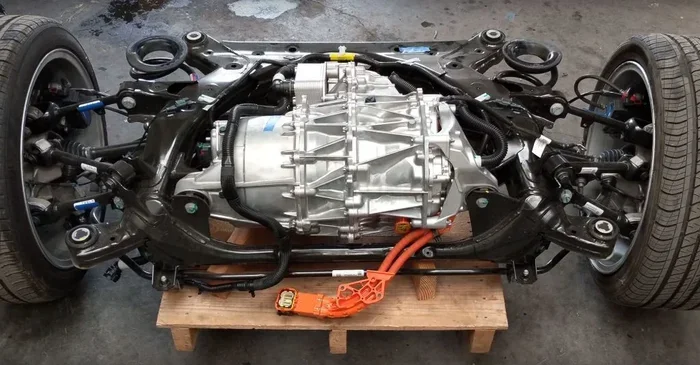
Understanding the Tesla drivetrain starts with the electric motor. The motor spins when electricity from the battery pack flows through it. That spinning motion goes directly into the single-speed gearbox. From there, it travels through the driveshaft to the wheels. The whole process is almost instant. There is no waiting, no lag, and no shifting.
The gearbox in a Tesla does one important job. It reduces the high rotational speed of the electric motor to a slower, more powerful rotation at the wheels. This is called a reduction gear. The motor might spin at 20,000 revolutions per minute or more. The wheels only need to spin at a few thousand RPM at highway speeds. The gearbox handles this conversion smoothly and efficiently.
The Role of the Electric Motor
The electric motor is the heart of the Tesla drivetrain. Unlike a gasoline engine, which needs to build up power through combustion cycles, an electric motor delivers full torque the moment you press the accelerator. This is why Tesla cars feel so quick off the line. The electric motor and the single-speed gearbox work together as a seamless unit.
There is no clutch in a Tesla. There is no torque converter either. The connection between the motor and the wheels is direct and simple. Fewer parts means fewer things that can break. It also means less maintenance. You never need to change transmission fluid in a Tesla because there is no traditional gearbox that requires it.
Single-Speed vs. Multi-Speed: What Is the Difference?
A single-speed gearbox has one fixed gear ratio. It does not shift. A multi-speed gearbox has several gears and shifts between them based on speed and load. Here is a quick comparison.
- Single-Speed Gearbox: One gear ratio, no shifting, smooth and instant power delivery, fewer moving parts, lower maintenance.
- Multi-Speed Gearbox: Multiple gear ratios, shifts between gears, power delivery has slight pauses during shifts, more moving parts, higher maintenance needs.
For most drivers, the single-speed setup in a Tesla is more than enough. The electric motor covers the entire speed range without needing to change gears. Some high-performance electric car makers have started experimenting with two-speed gearboxes, but Tesla has stuck with the single-speed design for all its models so far.
Tesla Models and Their Transmission Setup
All current Tesla models use a single-speed gearbox. This includes the Model S, Model 3, Model X, and Model Y. Each model has a slightly different motor configuration, but the transmission principle remains the same. Let us look at how this works across the lineup.
Model S and Model X
The Model S and Model X are Tesla larger vehicles. They come in both rear-wheel drive and all-wheel drive configurations. The all-wheel-drive versions use two electric motors, one in the front and one in the rear. Each motor has its own single-speed gearbox. This setup gives the car excellent traction and handling. The weight distribution is balanced, which helps with stability.
The Model S Plaid, in particular, is a great example of how effective this drivetrain is. With three motors and a combined output of over 1,000 horsepower, the car rockets from zero to 60 in under two seconds. And it does all of that without a single gear change. The Tesla transmission simply delivers the power smoothly and relentlessly.
Model 3 and Model Y
The Model 3 and Model Y are Tesla more affordable and compact offerings. They also use a single-speed gearbox. The standard-range versions typically have a rear-wheel-drive motor with one gearbox. The long-range and performance versions add a front motor for all-wheel drive.
The Model 3 Performance is a great example. It accelerates from zero to 60 in about 3.1 seconds. That is incredibly quick for a compact sedan. And yet the drivetrain is simple. One motor, one gearbox, one fixed gear ratio. The result is a car that is both fast and reliable.
You might also be interested in learning about how much weight different cars carry, which affects performance and drivetrain demands. Check out our article on 000 Lbs Heavy For A Car to understand how vehicle weight impacts the overall driving experience.
The Benefits of Tesla Simplified Transmission
Tesla chose a single-speed gearbox for good reasons. The benefits are clear and they directly improve the driving experience. Let us break down the main advantages.
1. Instant Acceleration
Because the electric motor delivers full torque from zero RPM, acceleration is immediate. There is no waiting for the engine to rev up. There is no gear shift pause. When you step on the pedal, the car surges forward instantly. This is one of the most noticeable differences between driving a Tesla and driving a gasoline car.
2. Smooth and Seamless Power
With only one gear, there is no shifting at all. The power delivery is completely smooth. You never feel a lurch or a pause during acceleration. This makes the driving experience feel refined and luxurious, even in the more affordable Model 3 and Model Y.
3. Less Maintenance
Fewer moving parts mean less wear and tear. There is no transmission fluid to change. There are no clutch plates to replace. There is no torque converter to worry about. The Tesla drivetrain is designed to last the life of the car with minimal maintenance. This is a huge advantage for owners who want to spend less time and money on repairs.
4. Better Reliability
Traditional automatic transmissions are complex. They have hundreds of moving parts, including planetary gear sets, clutch packs, and hydraulic systems. The Tesla single-speed gearbox has far fewer parts. This simplicity translates directly into better long-term reliability.
5. Improved Efficiency
Every time a traditional transmission shifts gears, there is a brief loss of power. Energy is lost in the mechanical transition between gears. With a single-speed setup, there is no such loss. The power from the battery flows directly to the wheels with minimal interruption. This helps Tesla achieve some of the best efficiency ratings in the electric vehicle market.
Common Misconceptions About Tesla Transmission
There are several misconceptions about how Tesla vehicles transmit power to the wheels. Let us clear up the most common ones.
Misconception 1: Tesla Has No Transmission at All
This is not true. Tesla vehicles do have a transmission. It is simply a single-speed gearbox rather than a multi-speed one. The reduction gear plays a critical role in converting the motor high-speed rotation into the slower, more powerful rotation needed to turn the wheels.
Misconception 2: Tesla Cars Need a Clutch
Electric motors do not need a clutch. A clutch is used in manual transmissions to disconnect the engine from the wheels while shifting gears. Since Tesla has only one gear and no shifting is required, a clutch is completely unnecessary. You never need to press a clutch pedal in a Tesla.
Misconception 3: Tesla Transmission Needs Fluid Changes
The single-speed gearbox in a Tesla does not use traditional transmission fluid. There is no hydraulic system, no clutch packs, and no planetary gears that need lubrication in the same way as a conventional automatic. This is another reason Tesla maintenance costs are lower than those of gasoline-powered cars.
Misconception 4: Tesla Cannot Handle High Speeds Without Multiple Gears
Some people believe that a single gear is not enough for high-speed driving. This is not the case. Modern electric motors are designed to operate efficiently at very high RPMs. Tesla motors can spin at well over 15,000 RPM. The reduction gear handles the conversion to wheel speed without any issues. Tesla cars comfortably cruise at highway speeds all day long on a single gear.
How Tesla Transmission Compares to Other Electric Cars
Tesla is not the only electric car maker using a single-speed gearbox. Most electric vehicles use this same approach. Companies like Nissan, Chevrolet, and BMW all use single-speed reductions in their electric models. The principle is the same across the industry. Electric motors deliver strong torque across a wide RPM range, so a single gear is sufficient.
However, some companies are experimenting with multi-speed gearboxes for electric cars. Porsche, for example, uses a two-speed gearbox in the Taycan. The first gear provides strong launch acceleration, while the second gear is optimized for highway cruising. This is a more complex setup, and it adds weight and maintenance requirements.
Tesla has chosen to keep things simple. The single-speed gearbox has proven to be reliable, efficient, and more than capable for everyday driving. It aligns with Tesla philosophy of using fewer, simpler parts to achieve better performance and lower costs.
What About the Tesla Cybertruck?
The Tesla Cybertruck uses a similar single-speed gearbox approach. Its electric motors deliver instant torque, and the reduction gear handles the speed conversion. The Cybertruck demonstrates that this drivetrain philosophy works across different vehicle types, from sedans to trucks.
Quick Tips for Tesla Owners
- Do Not Ride the Brake: Use regenerative braking to slow down. This charges the battery and reduces wear on the brake pads. There is no need to downshift because there is only one gear.
- Keep Tire Pressure Checked: Since the drivetrain is so simple, tire condition becomes even more important for efficiency and performance.
- Update Software Regularly: Tesla over-the-air updates can improve drivetrain performance and efficiency. Keep your car software up to date.
- Use Chill Mode for Daily Driving: If you find the instant torque too aggressive, switch to Chill mode. It smooths out acceleration and is easier on the drivetrain.
- Monitor Battery Health: A healthy battery delivers consistent power to the motor. Keep your charging habits smart to preserve battery longevity.
Key Takeaways
- Tesla uses a single-speed gearbox: There is no traditional multi-speed transmission in any Tesla model.
- Electric motors deliver instant torque: This eliminates the need for gear shifting entirely.
- Less maintenance, more reliability: Fewer moving parts mean fewer things to repair or replace.
- All Tesla models use the same principle: From the Model 3 to the Model S Plaid, every Tesla uses a single-speed reduction gear.
- No transmission fluid changes needed: The simplified drivetrain removes a major maintenance task.
- Regenerative braking replaces downshifting: Tesla uses motor resistance to slow the car instead of shifting to a lower gear.
- The design is industry-standard: Most electric vehicles use the same single-speed approach.
FAQ Section
Do Teslas Have a Traditional Automatic Transmission?
No, Teslas do not have a traditional automatic transmission. Instead, they use a single-speed reduction gear that connects the electric motor directly to the wheels. There are no gear shifts, no torque converter, and no multiple gear ratios. The system is much simpler than a conventional automatic gearbox.
Can You Shift Gears in a Tesla?
No, there are no gears to shift in a Tesla. The car operates in a single fixed gear ratio at all times. When you want to move forward, you select Drive. When you want to reverse, you select Reverse. The electric motor handles everything else. There is no clutch pedal and no gear selector beyond Drive, Reverse, and Park.
Does a Tesla Transmission Need Maintenance?
The Tesla drivetrain requires very little maintenance. There is no transmission fluid to change, no clutch to replace, and no gear shifts to wear out. The single-speed gearbox is sealed and designed to last the life of the vehicle. Routine maintenance focuses mainly on tire rotations, brake inspections, and battery health checks.
Why Does Tesla Not Use a Multi-Speed Gearbox?
Electric motors deliver strong torque across a wide range of speeds, so a multi-speed gearbox is unnecessary. A single gear ratio is enough to cover everything from low-speed city driving to highway cruising. Adding a second gear would add weight, complexity, and cost without providing meaningful benefits for most driving situations.
Do All Electric Cars Use the Same Single-Speed Transmission?
Most electric cars use a single-speed reduction gear, including Teslas, Nissans, Chevrolets, and BMWs. The basic principle is the same across the industry. Electric motors are naturally well-suited to single-speed drivetrains because they deliver power efficiently over a broad RPM range. Some high-performance EVs are experimenting with two-speed setups, but single-speed remains the standard.
Is the Tesla Drivetrain Good for Towing?
Yes, the Tesla drivetrain is well-suited for towing. The instant torque delivery from the electric motor provides strong pulling power from a standstill. Models like the Cybertruck and Model X are rated for significant towing capacity. The single-speed gearbox handles the load without any issues, and the lack of a traditional transmission means fewer components to stress under heavy loads.
Conclusion
Does Tesla have a transmission? Yes, it does. But it is not the kind of transmission you are used to. Tesla uses a single-speed gearbox that works seamlessly with the electric motor to deliver instant, smooth, and powerful acceleration. There are no gear shifts, no clutch pedals, and no transmission fluid changes. The drivetrain is simple, reliable, and incredibly effective.
The Tesla approach to power delivery is a big part of what makes electric cars feel so different from gasoline cars. Instant torque, seamless power, and minimal maintenance are all direct results of the single-speed transmission design. As electric vehicle technology continues to evolve, this simple but brilliant approach is likely to remain the standard.
Whether you drive a Model 3, a Model S, or a Model Y, you are experiencing the benefits of this streamlined drivetrain every time you hit the road. The next time someone asks you if a Tesla has a transmission, you can confidently say yes and explain exactly how it works. The simplicity of the Tesla drivetrain is one of the most underrated aspects of electric vehicle engineering, and it is a big reason why Teslas are so enjoyable to drive every single day.